Artificial Intelligence (AI)
Explain BFS and DFS.
Breadth-First Search (BFS) and Depth-First Search (DFS) are two fundamental graph traversal algorithms used to explore nodes and edges in a graph systematically.
Breadth-First Search (BFS)
How It Works:
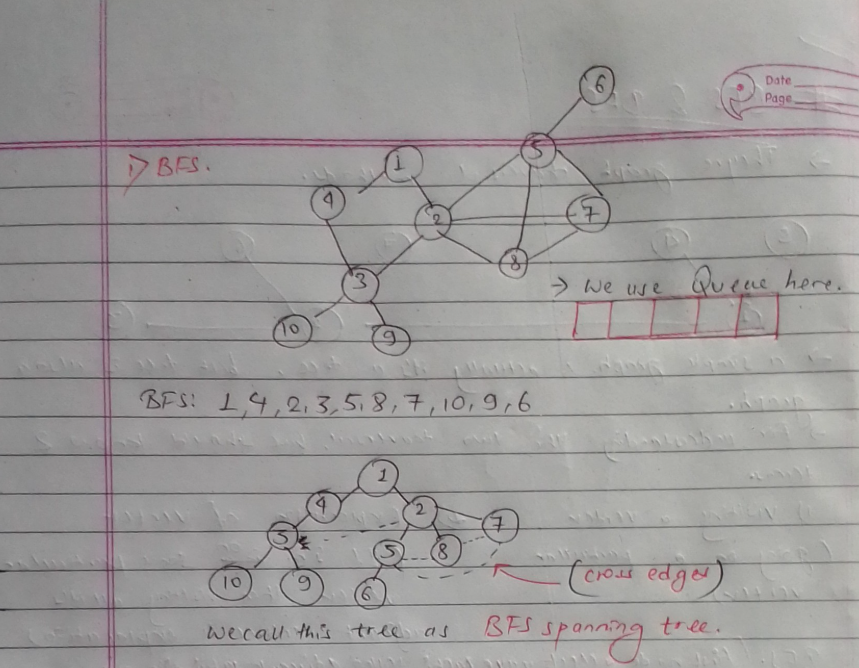
BFS explores the graph level by level.
It starts at the root node (or any arbitrary node in an unconnected graph) and visits all its neighbors before moving to their neighbors.
Typically implemented using a queue.
Algorithm:
Initialize a queue and enqueue the starting node.
Mark the starting node as visited.
While the queue is not empty:
Dequeue a node.
Process the node (e.g., print or store it).
Enqueue all its unvisited neighbors and mark them as visited.
Key Properties:
Time Complexity:
O(V+E), where V is the number of vertices and E is the number of edges.Space Complexity:
O(V).
Applications:
Finding the shortest path in an unweighted graph.
Network broadcasting.
Depth-First Search (DFS)
How It Works:
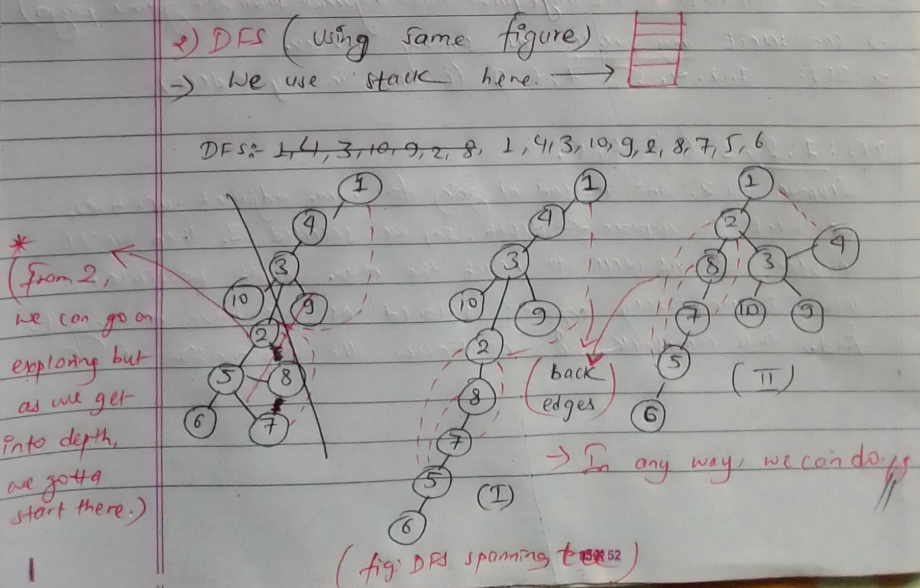
DFS explores as far as possible along a branch before backtracking.
It uses recursion (implicit stack) or an explicit stack for traversal.
Algorithm:
Start at the root node.
Mark the node as visited and process it.
Recursively visit all its unvisited neighbors.
Backtrack when there are no unvisited neighbors.
Key Properties:
Time Complexity:
O(V+E), similar to BFS.Space Complexity:
O(V).
Applications:
Detecting cycles in a graph.
Maze solving and backtracking problems.
Expert system explained briefly.
Expert System
An expert system is a computer program designed to mimic the decision-making ability of a human expert in a specific domain. It uses a knowledge base of facts and rules to analyze information and provide recommendations, solutions, or decisions.
Components of an Expert System
Knowledge Base
Contains facts and rules about a specific domain.
Facts: Known truths about the domain.
Rules: "If-Then" statements that guide the system's reasoning.
Example:
IF it is raining THEN carry an umbrella.
Inference Engine
The reasoning part of the system.
Applies logical rules to the knowledge base to draw conclusions or solve problems.
Two main types of reasoning:
Forward Chaining: Starts with known facts and applies rules to reach a conclusion.
Backward Chaining: Starts with a goal and works backward to see if the facts support it.
User Interface
- Allows users to interact with the system, input data, and receive results or explanations.
How Expert Systems Work
The user provides input (facts or a problem).
The inference engine applies the rules in the knowledge base to process the input.
The system provides an output, such as a decision, recommendation, or explanation.
Advantages
Consistency: Provides reliable and uniform answers without human error.
Availability: Can operate 24/7 without fatigue.
Efficiency: Speeds up problem-solving in complex domains.
Disadvantages
Limited to Specific Domains: Performs well only in the area it is programmed for.
Dependency on Knowledge Base: If the knowledge base is incomplete or inaccurate, the system's output will be flawed.
Lack of Common Sense: Cannot think beyond the rules it is programmed with.
Examples of Expert Systems
MYCIN: A medical expert system for diagnosing bacterial infections.
DENDRAL: Used in chemistry for analyzing molecular structures.
XCON: Helps configure computer systems.
What is AI? Differentiate between Strong AI and Weak AI. Some misconceptions about AI.
Artificial Intelligence (AI) refers to the simulation of human intelligence by machines, particularly computer systems. AI enables machines to perform tasks that typically require human cognition, such as learning, problem-solving, reasoning, perception, and understanding natural language.
Difference Between Strong AI and Weak AI (4 points)
| Weak AI (Narrow AI) | Strong AI (General AI) |
| It is limited to specific tasks or domains. | It can perform a wide range of tasks like a human. |
| It learns within predefined parameters; lacks flexibility. | Hypothetically, it can learn and adapt to any domain autonomously. |
| It does not possess consciousness or understanding. | Theoretically, it is capable of consciousness and self-awareness. |
| Examples: Chatbots, recommendation systems, self-driving cars. | Currently non-existent; depicted in science fiction (e.g., HAL 9000). |
Common Misconceptions About AI
Misconception 1:
AI systems reason and understand the way humans do.
Reality: AI mimics human decision-making in specific contexts, but does not truly think. Its understanding is based on algorithms, not cognition.
Misconception 2:
AI will lead to mass unemployment.
Reality: AI is expected to automate repetitive tasks but also create new job opportunities in fields like AI development, maintenance, and ethical governance.
Misconception 3:
AI can solve any problem.
Reality: AI is limited by its programming, data quality, and the scope of its application.
Misconception 4:
AI is a single, monolithic technology.
Reality: AI is a broad field encompassing many different technologies, including machine learning, deep learning, natural language processing, computer vision, and more.
Misconception 5:
AI is always fair and impartial.
Reality: AI learns from the data it's trained on. If that data reflects human biases (like racism or sexism), the AI will also learn and reflect those biases in its decisions.
Misconception 6:
AI is a new technology.
Reality: The field of AI has been around for decades. However, recent advances in computing power and data availability have led to a resurgence of interest in AI.
Various components of AI
- Learning
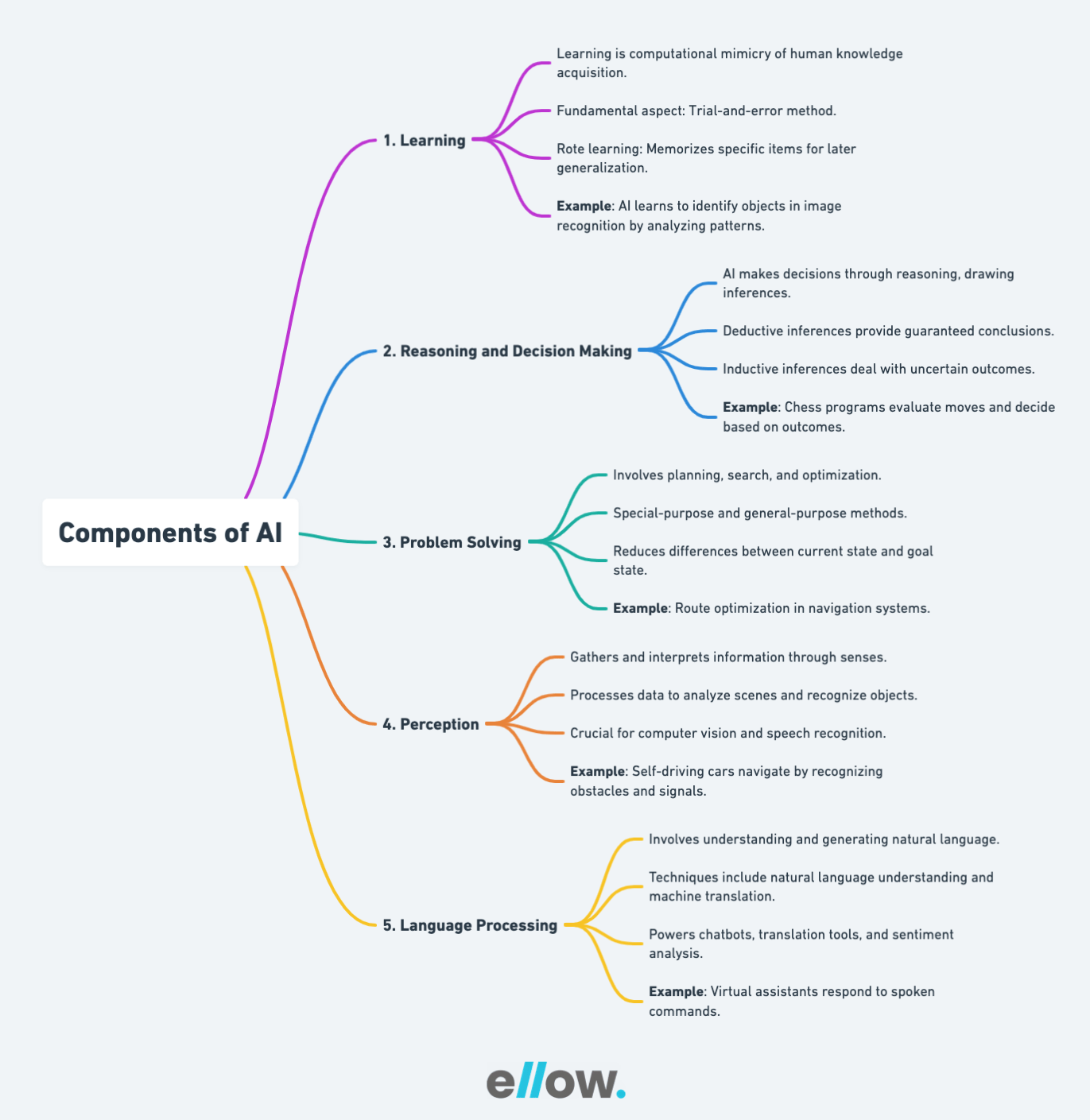
Learning in the context of AI is similar to how humans acquire knowledge but implemented computationally. One fundamental aspect of AI learning is the trial-and-error method. The AI system attempts various solutions to a problem and retains successful strategies in its database for future use.
Another form of learning is rote learning, where the AI memorizes specific items, such as problem-solving approaches, vocabulary, or foreign languages. This information is later generalized and applied in diverse contexts.
Example: Object recognition through image analysis.
2. Reasoning and Decision-Making
AI analyzes information and makes decisions through reasoning.
This involves drawing inferences from given situations, categorized as inductive or deductive.
Deductive inferences involve providing guaranteed conclusions, while inductive inferences deal with situations where outcomes are not certain.
Example: Chess programs evaluating moves.
3. Problem-Solving
AI’s problem-solving ability involves techniques like planning, search, and optimization.
Special-purpose methods tailor solutions to specific features of a given problem, while general-purpose methods address a wide range of diverse issues.
Problem-solving in AI includes step-by-step reduction of differences between the current state and the goal state.
Example: Navigation systems optimizing routes.
4. Perception
AI perceives its environment by gathering and interpreting information through various sensors (e.g., cameras, microphones).
This information is then internally processed to analyze scenes, recognize objects, and understand their relationships, features, and dynamics.
Perception is crucial for tasks like computer vision and speech recognition.
Example: Self-driving cars interpreting obstacles.
5. Language Processing
Language processing in AI refers to the ability to understand, interpret, and generate natural language.
This involves techniques like natural language understanding (NLU), machine translation, and text generation, enabling AI systems to effectively process and interact with human language.
These capabilities allow applications like chatbots, language translation tools, and sentiment analysis to function seamlessly.
Example: Virtual assistants responding to voice commands.
NLP Techniques
Natural Language Processing (NLP) is a field of artificial intelligence (AI) that focuses on the interaction between computers and human languages. It involves enabling computers to understand, interpret, and generate human language in a way that is both meaningful and useful.
Some NLP techniques:
Tokenization:
Tokenization is the process of breaking down a sentence or text into smaller pieces, called tokens. Tokens can be words, phrases, or symbols.
Example: In the sentence "I love AI," tokenization would split it into ["I", "love", "AI"].
Part-of-Speech (POS) Tagging:
POS tagging assigns a grammatical category to each word in a sentence (such as noun, verb, adjective, etc.).
Example: In "The cat sleeps," the tags would be [The: Determiner, cat: Noun, sleeps: Verb].
Named Entity Recognition (NER):
NER identifies entities (like names, dates, locations) within a sentence. This helps extract useful information from a text.
Example: In "Barack Obama was born in Hawaii," NER would identify "Barack Obama" as a person and "Hawaii" as a location.
Stemming:
Stemming reduces words to their base or root form by removing prefixes or suffixes.
Example: “running,” “runner,” and “runs” would all be reduced to the base word “run.”
Lemmatization:
Similar to stemming, lemmatization also reduces words to their base form. However, it ensures that the resulting word is a valid dictionary word (called a lemma), rather than just a stem.
Example: "Better" would be lemmatized to "good," whereas "running" would be lemmatized to "run."
Stop-word Removal:
Stop words are common words like “the,” “is,” and “in,” which do not contribute much meaning and are often removed during text processing to improve efficiency.
Example: In the sentence "The cat is on the mat," the stop words ["the", "is"] could be removed, leaving ["cat", "on", "mat"].
Sentiment Analysis:
Sentiment analysis identifies the sentiment or emotion expressed in a piece of text, such as whether it is positive, negative, or neutral.
Example: "I love this movie!" would have a positive sentiment, while "I hate waiting" would have a negative sentiment.
Dependency Parsing:
This technique analyzes the grammatical structure of a sentence by establishing relationships between words.
Example: In "She gave him the book," dependency parsing would identify that "She" is the subject, "gave" is the verb, and "book" is the object.
Text Classification:
Text classification assigns predefined categories or labels to a text. This is used in spam detection, topic categorization, etc.
Example: Classifying news articles into categories like sports, politics, or technology.
Text Summarization:
Text summarization condenses a long text into a shorter version while retaining the essential information.
There are two types:
Extractive Summarization: Selects and combines important sentences or sections directly from the text.
Abstractive Summarization: Generates new sentences to summarize the key points, often using deep learning.